Meme coin trading can turn a small bankroll into seven figures if you treat it as a full-time risk job
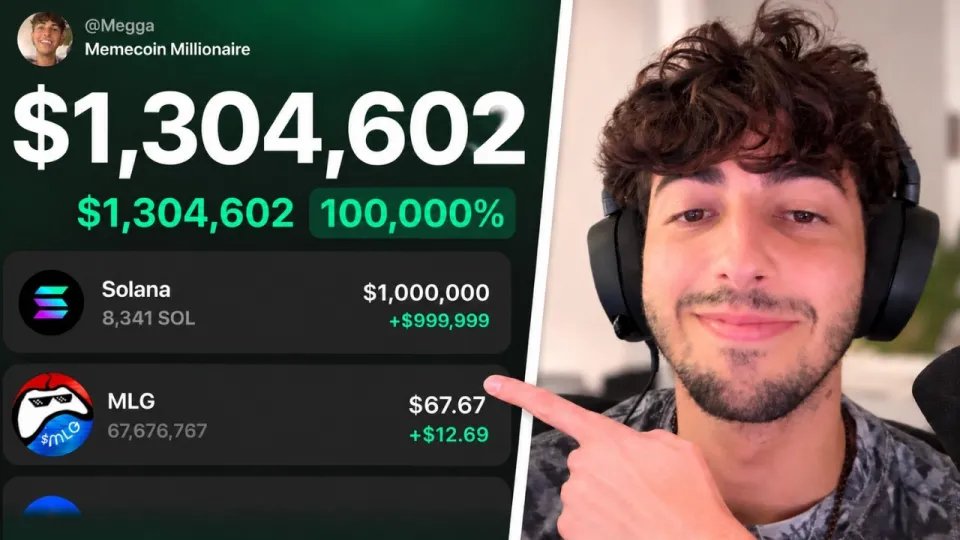
Video: How I Made $1,000,000 Trading Memecoins (FULL BREAKDOWN)
Want articles like this for your own video to promote it on YouTube and Google? Order them through the Telegram bot @sat_sit_bot. The bot writes and publishes the articles itself (with your YouTube video embedded) on popular topical websites (no ads). Free trial — 50 articles.
· based on the channel Megga
Meme coin trading is the practice of buying and selling tokens with no cash flow, no product and no fundamental valuation, where almost all of the edge comes from speed, narrative reading and strict risk control rather than from long-term holding. The trader Megga frames a seven-figure result the same way: not as a single lucky trade, but as a long run of small, repeatable decisions made inside a very noisy market. A free starter course linked in the video description is available here: free meme coin trading course.
What a meme coin actually is and why it moves so fast
A meme coin is a token whose price is driven almost entirely by attention, liquidity and timing, which is why it can multiply in hours and collapse in minutes. Unlike a token tied to a protocol's revenue, a meme coin has no earnings to anchor a valuation, so the only real inputs are how many buyers are watching, how much liquidity sits in the pool, and how quickly holders decide to exit.
That structure creates three practical consequences for anyone trading it:
- Liquidity is thin, so a modest buy can move the price and a large sell can crater it.
- Supply is often concentrated in a few wallets, which means a single holder can end the trade.
- The narrative — a mascot, a slogan, a community joke — is the product, and narratives decay fast.
Understanding this is what separates a trade from a gamble. If you cannot explain in one sentence why the next buyer will show up, you are the exit liquidity for someone else.
How the seven-figure result is actually assembled
A large meme coin profit is usually the sum of many medium-sized wins plus a handful of outliers, held together by the rule that no single loss is allowed to be fatal. The video's premise is a full breakdown of that process, and the structure it implies is unglamorous: long screen sessions, a repeatable checklist, and a bankroll that survives the bad weeks.
In practice the workflow looks like this:
- Scan continuously for new launches and for tokens that are re-accelerating after a quiet period.
- Check the contract and holder distribution before entering, not after.
- Size the position so a total loss costs a small, pre-agreed slice of the bankroll.
- Take partial profit into strength instead of waiting for a round number.
- Log every trade with the reason for entry, so patterns become visible over dozens of trades.
None of these steps is exotic. The compounding comes from doing them hundreds of times without skipping the boring parts.
The 9-to-12-hour question: what the hours are actually spent on
Time in front of the screen is the most misunderstood input in meme coin trading, because hours only pay if they contain deliberate repetition rather than passive watching. Viewers of the breakdown asked directly what fills a nine-to-twelve-hour day, and the honest answer is that most of it is not clicking buy.
A realistic session splits into four blocks:
- Preparation — reviewing overnight moves, tracking which wallets and communities are early to new narratives.
- Monitoring — watching order flow, holder counts and social velocity on a shortlist of candidates.
- Execution — entering, scaling out, and cutting without negotiating with yourself.
- Review — writing down what worked, what was luck, and what rule was broken.
If those four blocks are not visible in your day, adding hours will not change the outcome. The question is never how long you sat there, but how many decisions you made with a written reason behind them.
Risk rules that keep a meme coin account alive
Survival is the strategy in meme coin trading, because the market offers unlimited chances and a blown account removes all of them. The failure modes are consistent across traders: oversizing a conviction play, averaging down into a dying token, and keeping meaningful balances in wallets connected to unknown sites.
A workable rule set looks like this:
- Cap any single position at a small fixed percentage of the bankroll, and treat that cap as non-negotiable.
- Decide the exit before entry, including the price at which the thesis is simply wrong.
- Move profits out of the trading wallet regularly, so a good week cannot be erased by one bad click.
- Keep trading wallets separate from storage wallets, and never sign approvals you have not read.
- Stop for the day after a defined drawdown, because tilt costs more than fees.
Phishing and drained wallets come up repeatedly in the community around this video, and they are not bad luck — they are an operational risk that sits in the same bucket as position sizing.
Common questions from traders in drawdown
Drawdown is the normal state of a meme coin trader's early months, and the questions people ask about it tend to repeat. The most common is whether a specific all-time profit figure is enough to trade alongside others or to join group calls; the practical answer is that a track record matters less than a documented process, because a number without a method cannot be reviewed or improved.
A second recurring theme is how to judge whether a new narrative has real staying power. There is no clean signal, but useful checks include whether the community is producing original content rather than repeating a slogan, whether liquidity is growing alongside price, and whether the token survives its first sharp pullback with holders still present.
The third theme is time. Many people trade around a job, and the honest framing is that fewer hours with a written checklist beat long unstructured sessions; the constraint is focus, not attendance. Finally, a run of losses plus a security incident is the classic setup for revenge trading, and the correct response is to drop back to smaller size and simpler setups until decisions stop being emotional.
Useful links
- Free meme coin trading course
- Low-fee trading platform recommended in the video
- Megga on Twitch
- Megga on TikTok
- Megga on X
Final thoughts on building a meme coin track record
A seven-figure meme coin result is a story about repetition, not revelation: the same checks, the same position limits and the same review habit applied across hundreds of trades. The channel Megga is worth following precisely because the breakdown treats losses and screen time as part of the method rather than as footnotes. Anyone starting out should copy the process before copying the numbers, and should assume the first months are tuition. If you want the structured starting point, begin with the free course and keep your position sizes small until your own log proves an edge.
Key takeaways
- Meme coin PnL is built on many small, repeatable trades, not one lucky 100x.
- Megga describes 9–12 hour sessions in the 'trenches' as the baseline workload, not a shortcut.
- Position sizing and cutting losers matter more than picking the next viral ticker.
- Wallet hygiene is part of risk management: phishing drains wipe out months of gains.
- A free course and a low-fee trading platform are linked in the video description.
Questions & answers
How much capital do you need to start trading meme coins?
There is no fixed threshold, but the size of your account should be irrelevant to your rules: a position cap of a few percent of the bankroll works the same on a small or large balance. Starting small is an advantage, because early mistakes are cheaper and the process matters more than the number. What you actually need is enough to survive a long losing streak without changing your method.
How do you tell if a new meme coin narrative will last?
Look at behaviour rather than price: whether the community creates original content, whether liquidity grows with the market cap, and whether holders stay after the first sharp pullback. A token that only moves on repeated slogans usually has no second act. Treat any narrative call as a probability, not a certainty, and size it accordingly.
Can you trade meme coins while working a full-time job?
Yes, but the constraint is focus rather than hours. A short, structured session with a written checklist and pre-set alerts beats a long passive watch. Many traders use limit orders and alerts to avoid being glued to charts, and accept that they will miss some launches. Fewer, better-planned trades are a legitimate approach.
What should you do after a big loss or a drained wallet?
Stop trading, secure the remaining funds in a fresh wallet, and review what actually failed: sizing, approval hygiene, or the thesis itself. Revenge trading after a loss is the most common way a bad week becomes a bad quarter. Return at reduced size with simpler setups until decisions stop being emotional.
Source: How I Made $1,000,000 Trading Memecoins (FULL BREAKDOWN) · Markdown version